If you’ve been researching Black Locust decking, you’ve probably landed on a blog post or two that raises some red flags about the material. One post in particular — written by a tropical hardwood retailer — has been circulating widely. It argues that Black Locust is unreliable, that new-growth trees are fundamentally inferior to old growth, and then conveniently recommends Tigerwood (which they happen to sell) as the better choice.
We’ve been specializing in Black Locust for over 10 years. We’ve shipped it to thousands of customers covering all 50 USA states — residential decks, commercial boardwalks, rooftop terraces, coastal installations, and municipal parks in all climate types. We think you deserve an accurate assessment of this material — not a sales pitch dressed up as a warning.
So here it is: the real pros and cons of Black Locust decking.
THE REAL PROS
1. It Is Genuinely the Most Rot-Resistant Domestic Wood in North America
This isn’t marketing. It’s USDA data.
The USDA Wood Handbook (Table 14–1) ranks Black Locust in its highest durability class — “very resistant to decay” — the same category used for Teak. No other domestically grown lumber species available at commercial scale matches it. Not White Oak. Not Cedar. Not pressure-treated pine. See how Black Locust compares to other species →
Black Locust contains naturally occurring flavonoids and robinetin — organic compounds that actively resist rot, fungal decay, and insect infestation without any chemical treatment. This is why farmers have used Black Locust fence posts for generations, driving them directly into the ground and leaving them for decades.
2. The Strength Numbers Are Real — and Verified
Black Locust ranks in the top 3 of all strength categories measured by the USDA for North American species. Its Janka hardness rating of 1,700 lbf makes it roughly 30% harder than White Oak — itself one of the most respected domestic hardwoods. It’s harder than Walnut, harder than Cherry, and comparable to many tropical species that cost significantly more.
For a deck, hardness translates directly to resistance to denting, scratching, and wear. A Black Locust deck in a high-traffic area — a restaurant patio, a rooftop terrace, a park boardwalk — holds up in ways that softer materials simply cannot.
3. It’s a Sustainable Choice You Can Actually Verify
Unlike tropical hardwoods, Black Locust grows prolifically across the eastern United States. It reaches harvestable size in 20–40 years. Compare that to Ipe, which takes hundreds of years to mature — and which was added to the CITES Appendix II endangered species list in 2025, restricting its international trade.
Black Locust is not listed as a species of concern. It requires no chemical treatment. No heat treatment. No petroleum-based processing. It goes from forest to your deck as a natural wood product, full stop. FSC-certified Black Locust is available for projects requiring a verified chain of custody.
4. The Aging Is Beautiful, Not a Defect
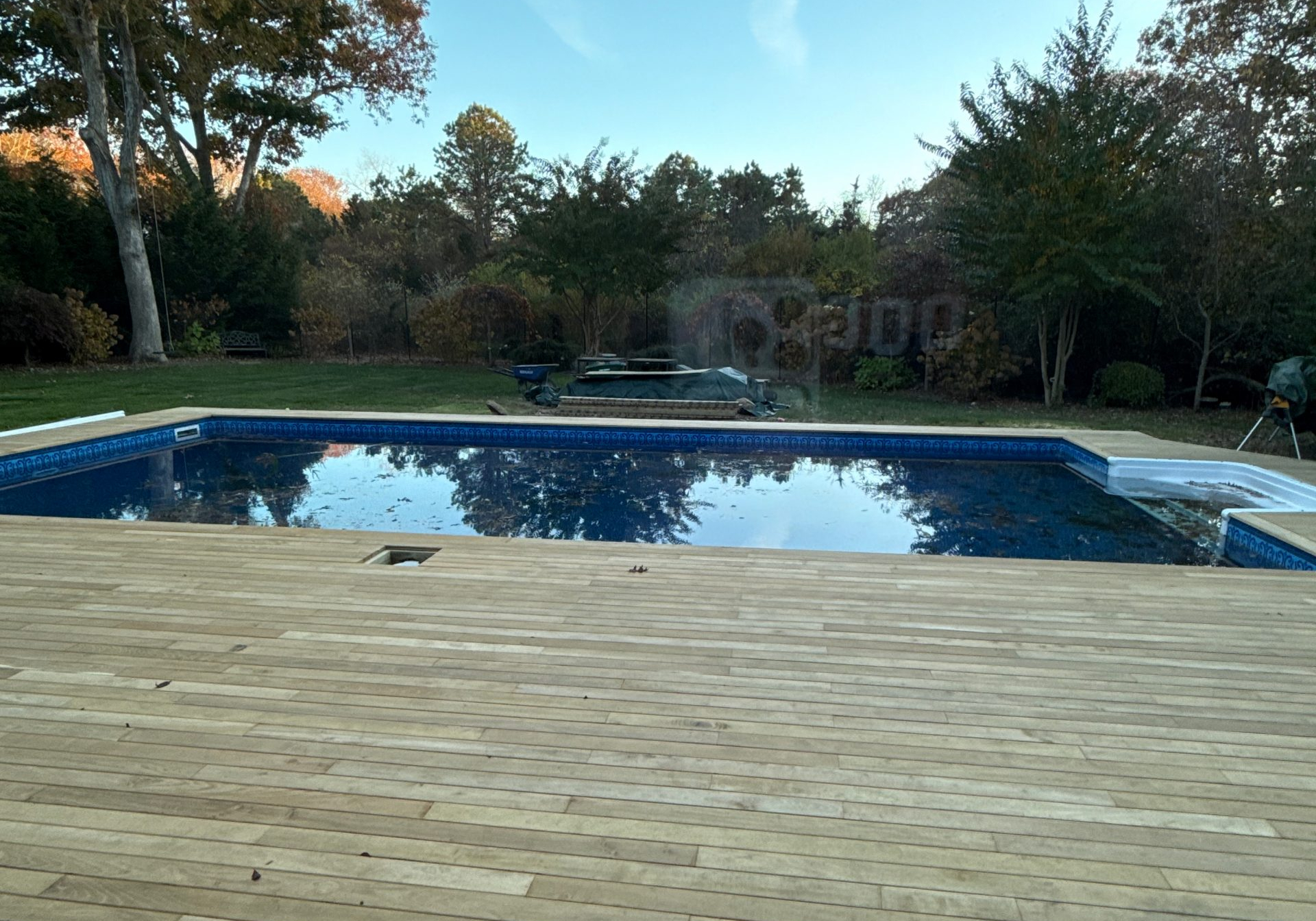
Left untreated, Black Locust weathers to a silver-gray patina — the same aesthetic that designers pay a premium for in Ipe and Teak. If you prefer to maintain the original warm amber tone, a simple periodic oil application will do it. Either way, the weathering process does not compromise the structural integrity or rot resistance of the wood. The flavonoids that protect the wood are in the cell structure — they don’t wash away.
5. It Performs Across Climates — Including the Harshest Ones
We have installed Black Locust on rooftops in Chicago, oceanfront decks in California and the Carolinas, boardwalks in Maine, and commercial projects in Las Vegas and Phoenix. The wood handles freeze-thaw cycling, salt air, arid climates, and UV exposure exceptionally well. This is why parks departments and municipalities increasingly specify it — they need materials that don’t require constant replacement.
THE REAL CONS (Yes, There Are Some)
1. It’s Harder to Work With Than Softwoods
This one is true. Black Locust’s extreme density means it requires carbide-tipped saw blades and pre-drilled holes for fasteners. If you’re a DIYer used to working with pressure-treated pine, there will be a learning curve.
That said, this is true of virtually every hardwood. Black Locust is actually easier to work with than most tropical hardwoods — and unlike Ipe sawdust, Black Locust doesn’t produce toxic particles. Hire an experienced hardwood installer, and this consideration disappears.
2. Board Lengths Are Shorter Than Some Species
Because Black Locust trees don’t grow as tall and straight as plantation softwoods, getting long, clear boards is more challenging. Twelve feet is typically the practical maximum for standard decking boards. For most residential decks and many commercial projects, this is a non-issue — shorter boards are common in hardwood flooring and decking installations. And Robi Decking now offers finger-jointed Black Locust boards for projects that require longer runs.
3. Natural Color and Grain Variation
Black Locust has natural variation in color — ranging from pale amber to golden brown — and visible grain character. If you want completely uniform, consistent-looking boards, you should probably be looking at composite decking (though that comes with its own trade-offs, including heat retention and plastic waste).
If you appreciate the look of natural wood, this variation is a feature. Architects frequently tell us it’s one of the primary reasons they specify Black Locust.
4. Higher Upfront Cost Than Softwoods
Black Locust costs more than pressure-treated pine or cedar. It costs less than most tropical hardwoods. When evaluated over a 20- or 30-year ownership period — accounting for the maintenance, refinishing, and replacement costs of cheaper materials — it typically delivers a lower total cost of ownership. But the initial check is larger, and that’s worth knowing.
ADDRESSING THE MISLEADING CLAIMS
“New growth Black Locust isn’t as good as old growth”
This claim, made by at least one tropical hardwood retailer, deserves a direct response as old-growth is defined as trees 120 years and older. First off there is no such thing as old-growth Black Locust — the tree is one of the shortest lived trees in the forest per the USDA: “In general, black locust trees are fast growing but short lived, living approximately 90 years.” As the tree is generally harvested between 20 and 60 years of age, the old-growth argument is a moot point.
The relevant question is whether commercially available new-growth Black Locust still outperforms the alternatives. According to the USDA Wood Handbook — the authoritative scientific reference — it does. Black Locust’s natural decay resistance, hardness, and strength are properties of the species, not exclusively of old-growth specimens.
The old-growth vs. new-growth argument is also applied selectively and misleadingly. Softwoods like Cedar, Pine, Cypress, and Redwood must be old-growth to achieve rot resistance. However, most hardwoods like Black Locust achieve rot resistance at an early age, typically at 5 years old as the natural flavonoids and robinetin develop early.
It’s also worth asking: who is making this argument? If the source is a retailer who sells Tigerwood, Ipe, or other tropical hardwoods, consider their incentive carefully.
The Squibb Park Bridge Story
The Squibb Park Bridge in Brooklyn is occasionally cited as evidence that Black Locust fails. Here’s the full picture: the bridge experienced structural bouncing issues caused by its suspension design — a structural engineering problem, not a wood failure. Subsequent closure due to wood deterioration involved a complex mix of factors including the sourcing and installation specifications of that particular project.
One bridge project with documented installation complications is not a data point that overrides thousands of successful Black Locust installations across North America — including municipal boardwalks, commercial restaurant decks, and rooftop terraces. We’d encourage you to look at our project gallery, which spans every climate region in the USA and into Canada and the Bahamas/Caribbean.
THE BOTTOM LINE
Black Locust is not a perfect material — no decking material is. It costs more upfront than softwoods, it requires experienced installation, and its natural variation isn’t for everyone.
But it is genuinely the most rot-resistant, durable domestic wood species available in North America. It is sustainably grown, chemical-free, and FSC-certifiable. And it has a track record — on decks, boardwalks, rooftops, and coastal installations — that speaks for itself.
When you read a “pros and cons” article that ends with a recommendation for a specific tropical hardwood the author happens to sell, read that with appropriate skepticism. Furthermore, why does that supplier request quotes from us and order Black Locust from us?
We’re happy to send you samples, connect you with past customers, and walk you through whether Black Locust is the right choice for your specific project.