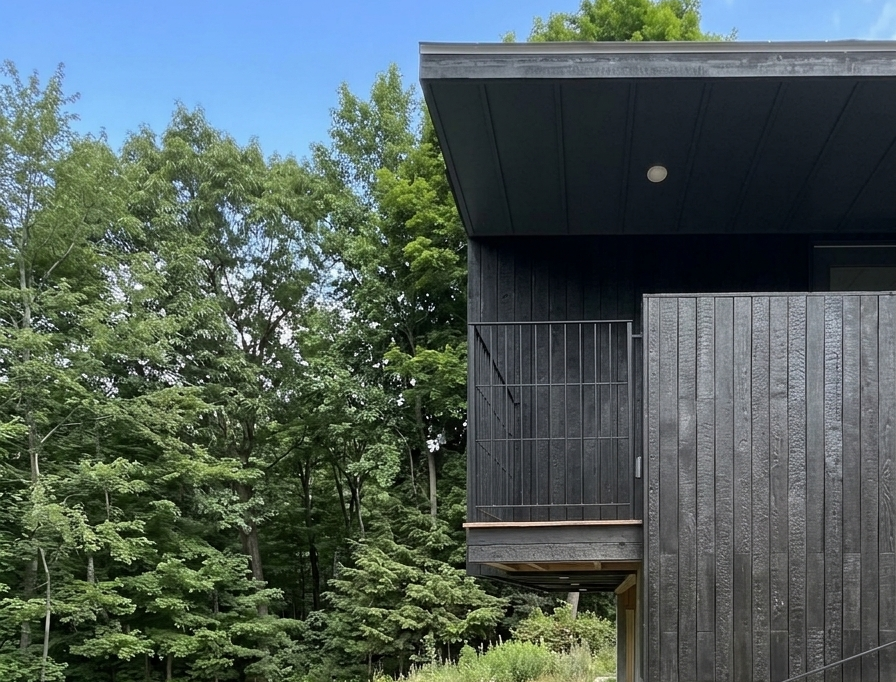
There’s a look in modern architecture that stops people in their tracks. Deep, dark, almost black wood with a surface that seems to absorb light rather than reflect it. Subtle grain visible beneath a richly textured finish. A material that feels simultaneously ancient and strikingly contemporary.
That look has a name: Shou Sugi Ban. And it has been turning heads on building facades, decks, siding installations, and interior feature walls for the past two decades.
But behind that striking aesthetic lies a process — and a set of trade-offs — that aren’t always obvious. Understanding the history and science of Shou Sugi Ban makes it easier to evaluate the options now available, including newer approaches that achieve the same visual result through very different means. Here’s the full story.
What Is Shou Sugi Ban?
Shou Sugi Ban — known in Japan as Yakisugi (焼杉), meaning “burnt cedar” — is a traditional Japanese method of wood preservation that involves charring the surface of wood with fire, which creates a unique aesthetic and improves its durability.
The technique originated in the 17th–18th century during the Edo period. The surface of the wood is intentionally burned with flame, then the carbonized layer is brushed off and the wood is treated with natural oil. This process gives the wood exceptional durability, resistance, a distinctive aesthetic appearance, and natural protection against pests.
A quick note on terminology: the term “Shou Sugi Ban” is often used as the Western designation for this traditional technique, but it is a phonetic variation arising from incorrect transcriptions of Japanese. The authentic Japanese term is Yakisugi, and “Shou Sugi Ban” is not actually used in Japan. We use both terms here since both are widely recognized in the design and architecture community.
The History: From Edo-Period Preservation to Global Design Trend
Charring wood is not a new concept — humans started modifying wood with fire around 400,000 years ago. In addition to basic fire-hardening, boat and fence post bottoms were routinely burned to prevent rot and increase longevity. Centuries-old structures clad in charred wood and oral tradition dating back to the Edo period (1603–1867) suggest yakisugi has been practiced for generations.
Historically it served a practical purpose: in densely packed Japanese cities and villages where wooden structures stood side by side, a fire-resistant, rot-resistant exterior cladding was essential. Charring achieved both. Prior to the 1970s, Shou Sugi Ban had a reputation as a poor man’s building material, often installed on storehouses in industrial zones.
Its renaissance came when the technique regained popularity in Japan in the 1970s, giving rise to mills specializing in large-scale manufacture. Architects like Yoshifumi Nakamura became internationally known for projects featuring charred wood, holding special exhibitions and workshops that brought the technique to global attention. Today it appears on some of the most celebrated buildings in contemporary architecture — from residential siding in Scandinavia to commercial facades in New York and London.
The Traditional Process: How Yakisugi Is Made
In the traditional procedure, three boards of sugi are bound together to form a triangular chimney shape. Fire is lit at the very bottom with paper or newspaper, and the stack effect of the triangle drives the flame upward, charring the interior faces of all three boards simultaneously. The process takes just a few minutes — long enough to char the outer 3–4mm of the wood at temperatures exceeding 400°C. The boards are then separated and the fire extinguished with water.
After charring, the boards are brushed to remove loose carbon, revealing the dramatic grain pattern beneath. The final step is an application of natural oil — traditionally tung oil or linseed oil — to protect and seal the surface.
The depth of char determines the final aesthetic — from a light “brushed” finish that reveals warm wood tones beneath the carbon, to a deep “alligator” char that produces a dramatically cracked and textured black surface. Traditionally the technique used Japanese cedar, but today it is applied to other species including spruce, pine, and larch.
The Environmental Case Against Traditional Charring
The traditional Shou Sugi Ban process is genuinely impressive — and for purists working on historically informed projects, authentic yakisugi has its place. But the burning process comes with real environmental trade-offs:
- Carbon emissions. Charring wood at high temperatures releases CO₂ and other combustion byproducts. For large commercial installations requiring thousands of linear feet of material, the emissions from the charring process are significant.
- Energy intensity. Whether done traditionally with open flame or industrially with specialized machinery, the charring process is energy-intensive — a real component of the product’s embodied carbon footprint.
- Wood species limitations. Authentic yakisugi uses Japanese cedar — not sustainably available at commercial scale outside Japan. Western producers typically substitute softwoods that char differently and don’t achieve the same structural results. The aesthetics may look similar; the performance properties often don’t match.
- Consistency challenges. Hand-charring is a skilled craft. Large-scale production introduces variability in char depth, finish, and appearance that is difficult to control without specialized industrial equipment.
For architects and builders working toward low-carbon or net-zero projects, these considerations matter. The aesthetic may look sustainable; the production process is more complicated.
Introducing Robi Sugi Ban: The Look, Without the Fire
This is where the conversation shifts from the traditional technique to what’s now possible with different materials and processes.
The core appeal of Shou Sugi Ban has always been the aesthetic — the depth of color, the way the grain reads through a dark finish, the sense of craft and permanence it communicates. None of that requires actual combustion. What it requires is the right material, treated the right way.
At Robi Decking, we started with a substrate that is already one of the most durable and sustainable hardwoods available — Black Locust — and developed a stain-based process that achieves the deep, rich, dark tones of traditional charred wood without fire, without combustion byproducts, and without the limitations of softwood substrates. We call it Robi Sugi Ban.
The result is a product that combines:
- The aesthetic of Shou Sugi Ban — deep, dark, architecturally striking
- The durability of Black Locust — the highest natural rot resistance classification in the USDA Wood Handbook, a Janka hardness of 1,700 lbf, and a documented lifespan of 25–40+ years
- The sustainability of a fast-growing species — Black Locust reaches harvestable size in 20–30 years, fixes nitrogen in the soil, and requires no chemical treatment beyond the stain finish itself
- The simplicity of a stain process — no fire, no combustion byproducts, no specialized charring equipment, and a consistent, controllable result across large installations
Robi Sugi Ban vs. Traditional Shou Sugi Ban: How They Compare
| Traditional Yakisugi | Robi Sugi Ban | |
| Substrate | Japanese cedar / softwood | Black Locust hardwood |
| Process | Open flame charring | Penetrating stain |
| Natural rot resistance | Moderate (cedar/softwood) | Very High (USDA highest class) |
| Janka hardness | ~350 lbf (cedar) | 1,700 lbf |
| Carbon footprint of production | Higher (combustion) | Lower (stain only) |
| Aesthetic | Charred texture, deep black | Deep black tones, grain-forward |
| Availability | Specialty order, long lead times | Ships in 3–10 business days |
| Applications | Primarily siding/cladding | Decking, siding, and more |
The key difference: traditional Shou Sugi Ban achieves its durability by transforming a soft, less durable species through burning. Robi Sugi Ban starts with a species that already outperforms the charred result — and adds the aesthetic on top.
Applications
Robi Sugi Ban is available for a range of applications where the dark, dramatic Shou Sugi Ban aesthetic is desired. Browse our project gallery to see Black Locust across application types:
- Exterior decking — the combination of Black Locust’s durability and the Sugi Ban finish creates a surface that performs and looks exceptional in coastal, rooftop, and high-traffic environments
- Exterior siding and cladding — delivering the architectural statement of charred wood on a substrate that doesn’t require the fire
- Accent walls and feature elements — interior and exterior feature walls where the aesthetic is the primary goal
- Commercial and hospitality projects — for architects and designers seeking a distinctive material with a credible sustainability story
Architects can download BIM files and technical specifications for project documentation and LEED support.
The Bottom Line
Shou Sugi Ban’s appeal isn’t a trend. The aesthetic is rooted in centuries of craft, and its popularity in contemporary architecture reflects a genuine hunger for materials that feel honest, tactile, and timeless. That appetite isn’t going away.
What is changing is the standard of scrutiny applied to the sustainability claims of building materials. A product that looks sustainable needs to actually be sustainable — in its source material, its production process, and its lifespan.
Robi Sugi Ban delivers on all three. Fast-growing Black Locust. Stain-based process. A finished product that will outlast the building trend that inspired it.
→ Shop the Robi Sugi Ban finish on our Accessories page
Interested in specifying Robi Sugi Ban for a project? Contact our team for technical data sheets, BIM files, and project support.