If you’ve been researching Black Locust decking for more than ten minutes, you’ve probably encountered the Janka hardness rating. It shows up on every species comparison chart, and suppliers regularly cite it as evidence of superiority. But unless you understand what the Janka test actually measures — and what it doesn’t — the number is hard to put in context.
Here’s a practical breakdown of Black Locust’s hardness, what it means for your project, and where hardness matters less than people think. For a broader look at all performance specs, see our technical data page.
What the Janka Test Actually Measures
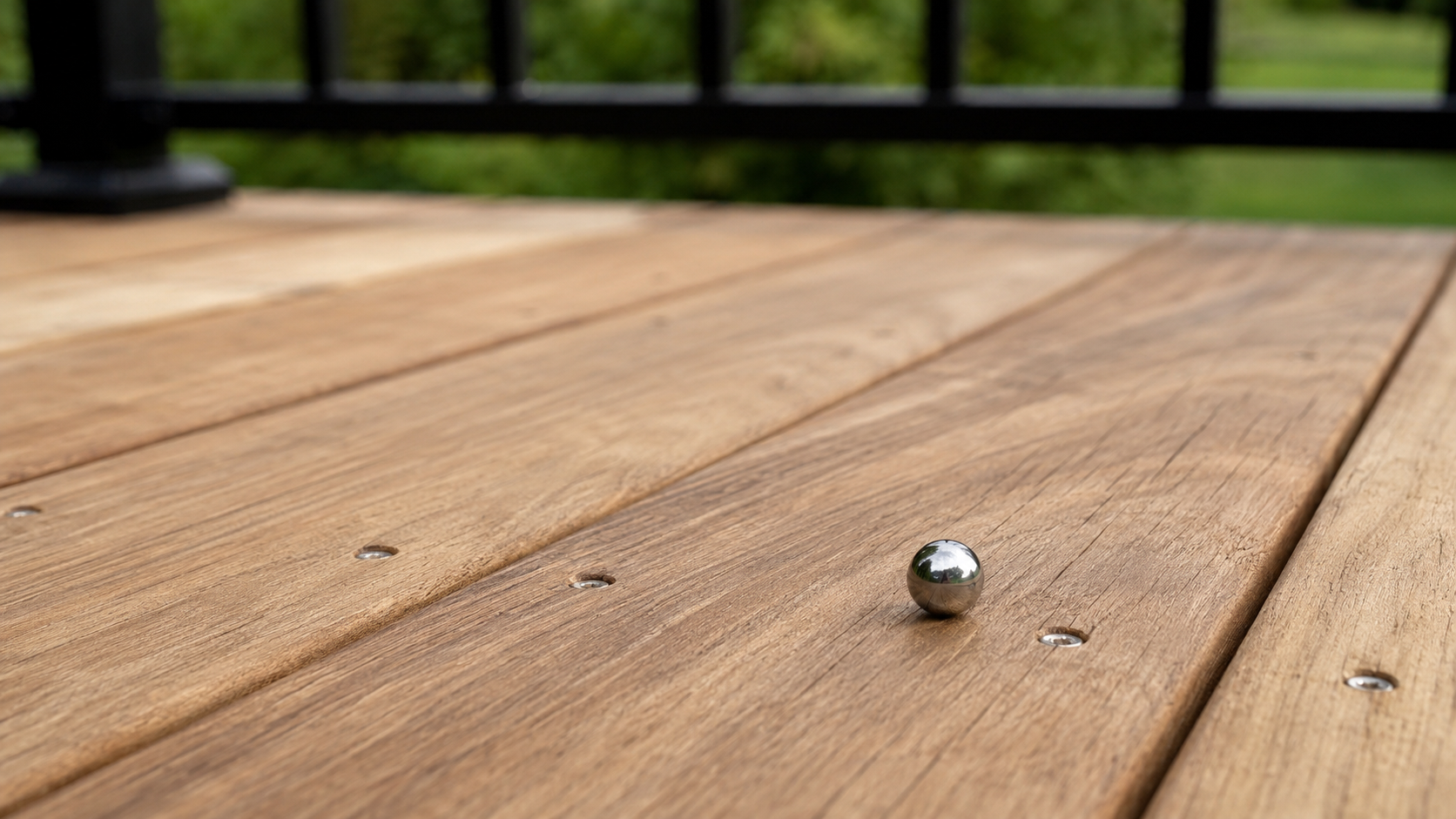
The Janka hardness test measures the force required to embed a steel ball (0.444 inches in diameter) halfway into a wood sample. The result is expressed in pounds-force (lbf) in the United States. It’s a standardized, reproducible test that gives a useful indicator of a wood’s resistance to surface denting and wear.
Black Locust’s Janka rating: 1,700 lbf.
For context:
- Ipe: ~3,680 lbf
- Black Locust: 1,700 lbf
- White Oak: 1,360 lbf
- Walnut: 1,010 lbf
- Douglas Fir: 660 lbf
- Western Red Cedar: 350 lbf
- Pressure-treated Southern Yellow Pine: 870 lbf
Black Locust is roughly 25% harder than White Oak, 70% harder than Douglas Fir, and nearly 5x harder than Western Red Cedar. It is softer than Ipe, which at 3,680 lbf sits near the top of all commercially available decking species. For a full head-to-head, see Black Locust vs. Ipe: The Complete 2026 Comparison.
What Hardness Means for Decking Performance
On a deck surface, hardness primarily affects resistance to denting, scratching, and wear from foot traffic, furniture, and dropped objects. Higher Janka ratings mean:
- Less denting from heavy furniture or dropped tools
- Better resistance to scratching from chairs, debris, and pet claws
- Better long-term appearance retention on high-traffic surfaces
At 1,700 lbf, Black Locust performs excellently across all of these dimensions for residential and most commercial applications. The practical difference between 1,700 and 3,680 lbf on a deck surface — as opposed to, say, a hardwood floor under office chairs — is minimal for most users.
What Hardness Does NOT Measure
This is where many species comparison charts mislead buyers.
Janka hardness does not measure rot resistance. Some of the most rot-resistant species — Black Locust, Western Red Cedar — are not the hardest. Some extremely hard tropical species have no meaningful field data on long-term decay resistance. For the real durability story, see How Long Does Black Locust Decking Last? Real-World Data.
Janka hardness does not measure dimensional stability. Some very hard woods move significantly with moisture changes. Some softer woods are remarkably stable.
Janka hardness does not measure how long a deck will last. Durability is primarily a function of natural decay resistance, not surface hardness. A very hard species with poor rot resistance will fail on a deck. A moderately hard species with exceptional rot resistance — like Black Locust — will outlast the harder species if the latter is not treated.
What the Hardness Means for Installation
Black Locust’s 1,700 lbf hardness does have real installation implications:
- Pre-drilling is required for all fastener locations — without pre-drilling, the wood will split
- Carbide-tipped saw blades are needed — standard blades will dull quickly
- Installation takes longer than softwood — budget additional labor time
These are not arguments against Black Locust. They’re standard requirements for any quality hardwood installation, and any experienced hardwood installer will be familiar with them.
The Bottom Line on Hardness
Black Locust’s 1,700 lbf Janka rating places it among the hardest sustainably grown decking species available anywhere — harder than any softwood, harder than White Oak, and comparable to many tropical hardwoods. Combined with its exceptional natural rot resistance (the USDA’s highest classification) and a growth cycle measured in decades rather than centuries, it delivers a combination of performance and sustainability that no tropical hardwood can match.
Ipe is harder. But it is CITES-listed, harvested from slow-growing old-growth tropical forests, and in practical decking applications, the hardness advantage rarely manifests as a meaningful real-world difference. For any project where performance, sustainability, and total cost of ownership all matter, Black Locust remains the most defensible choice. Compare all species →