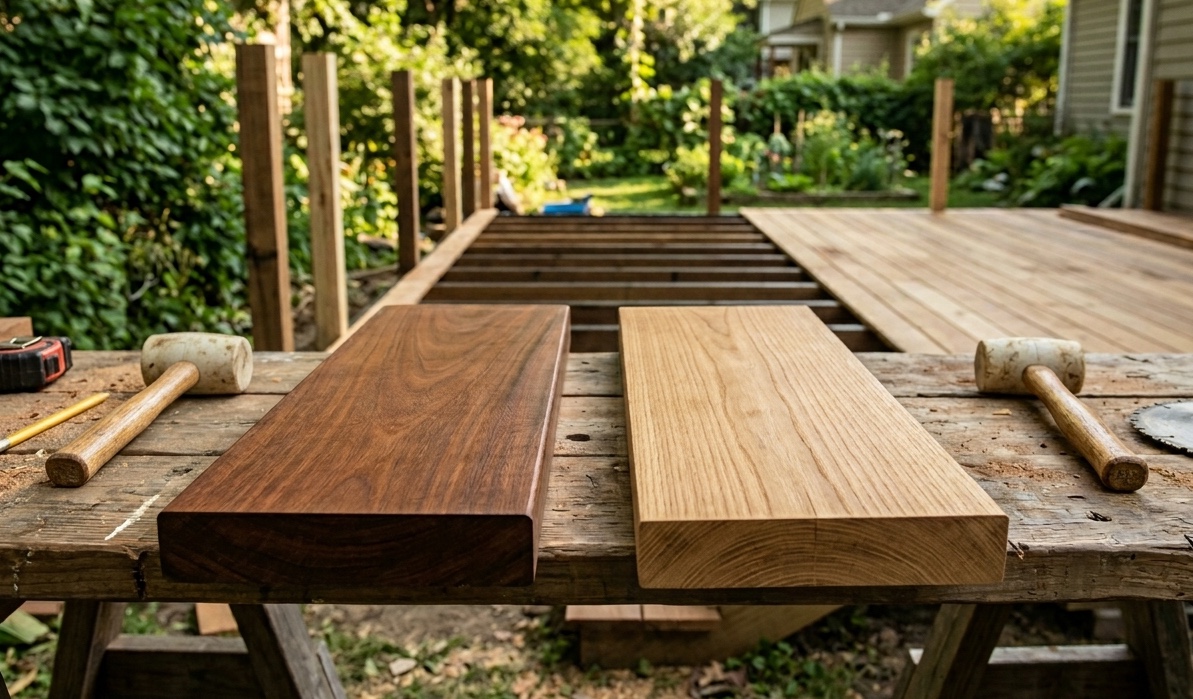
For years, the conversation about premium hardwood decking started and ended with Ipe. Dense, durable, beautiful — it was the benchmark everything else was measured against. Black Locust was the quietly excellent domestic alternative that specialists knew about but the mainstream market largely ignored.
In 2025, with Ipe now listed on CITES Appendix II and supply chains tightening, that’s changing fast. Here’s the full comparison.
Hardness and Strength
Ipe’s Janka hardness rating is approximately 3,680 lbf. Black Locust comes in at 1,700 lbf — roughly half. By that number alone, Ipe wins.
But here’s the nuance: the practical difference on a deck surface is minimal. Both species are dramatically harder than any softwood, any composite, and any thermally modified product on the market. The wear resistance difference between 1,700 and 3,680 lbf doesn’t manifest on a deck the way it would on, say, a hardwood floor with constant foot traffic. Both will outlast softwoods by decades.
Where Black Locust’s lower density actually becomes an advantage: it’s significantly easier to work with. Carbide blades are still required, but the installation labor is less intense than Ipe, which is notoriously brutal on tools.
Natural Durability and Rot Resistance
This is where the comparison gets interesting.
The USDA Wood Handbook classifies both Ipe and Black Locust in the highest decay resistance tier: “very resistant.” Black Locust’s natural durability comes from flavonoids and robinetin compounds in the wood’s cell structure — organic compounds that actively inhibit rot, fungal growth, and insect infestation without any treatment.
Both species, properly maintained, can last 25–50 years or more on a deck. Both weather to a silver-gray patina if left untreated. Both can be oiled to maintain their original color. On raw durability, these two species are genuine peers.
Sustainability
This is where Black Locust wins decisively.
Ipe grows in tropical rainforests in Brazil and takes 200–300 years to reach harvestable size. It has now been added to CITES Appendix II, restricting international trade due to overharvesting. Even “certified” Ipe has faced persistent scrutiny over the reliability of FSC claims in Brazilian supply chains. For a full breakdown of what the listing means, see What the CITES Appendix II Listing Means for Your Deck Project.
Black Locust is native to the eastern United States. It’s considered a fast-growing pioneer species — in many regions it’s classified as invasive due to how aggressively it colonizes disturbed land. It reaches harvestable size in 20–30 years, can be grown at high density, and actively improves soil quality through nitrogen fixation. FSC-certified Black Locust is available through Robi Decking.
There is no credible comparison on sustainability. Black Locust is the clear choice for any project with green building goals, LEED certification, or institutional procurement standards.
Supply Chain and Availability
Ipe: imported from Brazil, increasingly subject to export permit requirements, longer lead times, and price volatility. The CITES listing adds compliance complexity for commercial projects.
Black Locust: domestic, stable supply, ships nationwide with 3–10 business day order-to-delivery on standard items. No import documentation. No trade restrictions. See our project gallery for real-world installations across every climate zone.
Cost
Ipe has historically been priced at a premium reflecting its tropical origin and long harvesting cycle. That premium is rising as CITES restrictions tighten supply. Black Locust typically comes in at a lower price per board foot for equivalent grades — and that gap is likely to widen. For a detailed cost breakdown over time, see our 10-year cost comparison with pressure-treated pine.
The Verdict
If you specified Ipe in the past for its durability and aesthetics, Black Locust delivers comparable real-world performance with a dramatically better sustainability profile, domestic supply chain, and increasingly favorable price comparison. The 2025 CITES listing isn’t a reason to panic — it’s a reason to make a switch you should probably have made already. Compare all decking species side by side →