Black Locust is having a moment. With Ipe now CITES-listed and the broader market waking up to the environmental cost of slow-growing tropical hardwood harvesting, demand for Black Locust decking has grown significantly. If you’re researching it for the first time — or looking to spec it on a project — this guide covers everything you need to know.
What Is Black Locust?
Black Locust (Robinia pseudoacacia) is a fast-growing hardwood species that reaches harvestable size in just 20–30 years. It’s a pioneer species — one of the first trees to colonize disturbed land — and grows aggressively, making it one of the most renewable hardwood resources available. It fixes nitrogen in the soil, actively improving land quality as it grows, and requires no chemical treatment at any stage of production.
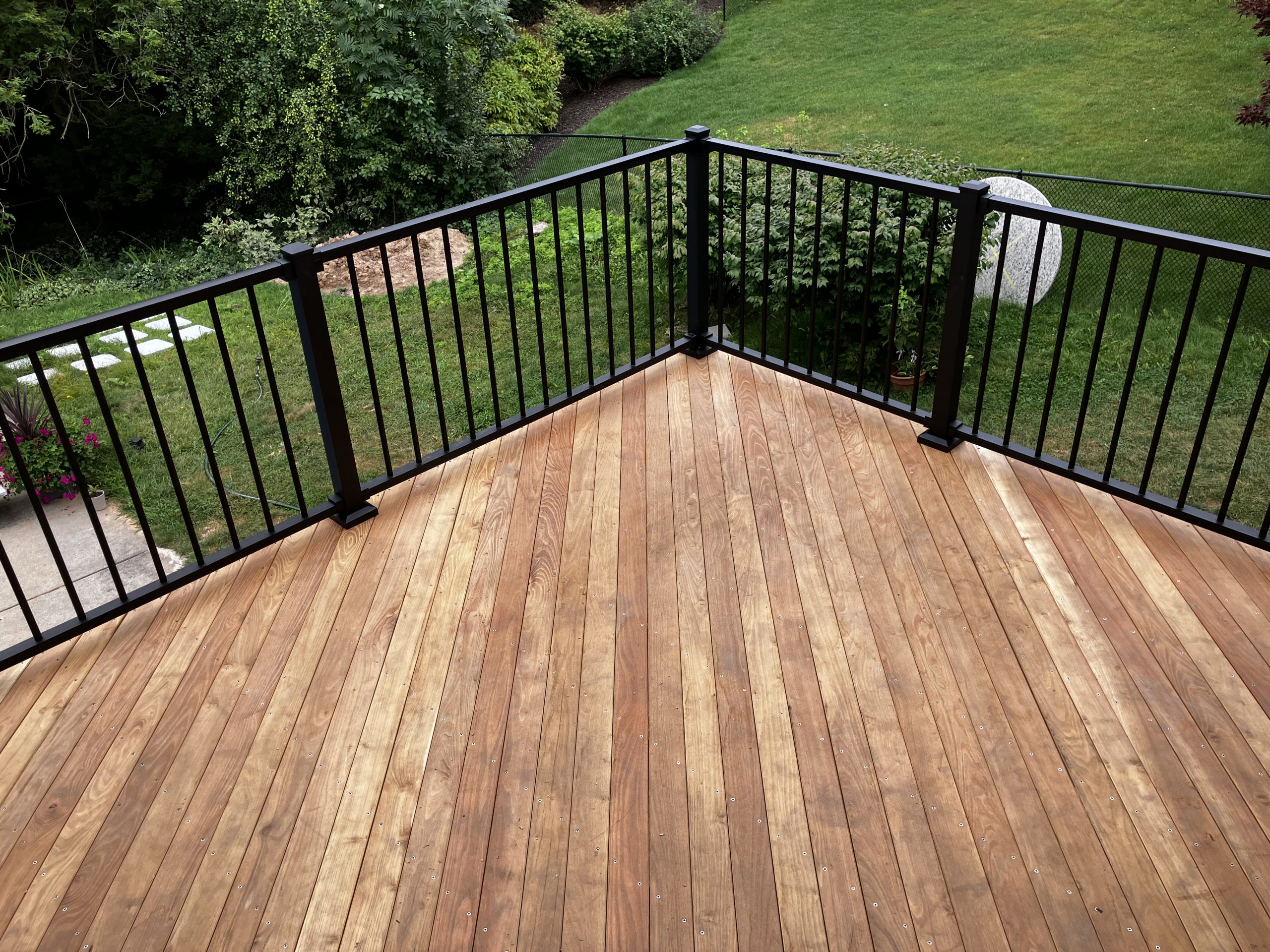
The wood itself is dense, ring-porous, and golden-amber in color when freshly milled. It contains natural flavonoid compounds (primarily robinetin) that make it highly resistant to rot, fungal decay, and insect damage — properties that develop early in the tree’s growth cycle and persist for the life of the wood.
Performance Characteristics
- Janka Hardness: 1,700 lbf (harder than White Oak, Walnut, and most hardwood species)
- USDA Decay Resistance Class: Very Resistant (highest tier)
- Modulus of Rupture: 22,000 psi (among the highest of any hardwood species)
- Density: ~48 lbs/ft³ (denser than most hardwoods, lighter than Ipe)
- Dimensional Stability: Moderate — proper drying and installation gaps are important
Available Products
At Robi Decking, Black Locust is available in the following forms:
- Decking boards (standard and finger-jointed for longer runs)
- Deck tiles (for rooftop and modular applications)
- Permeable wood pavers
- Siding
- Structural lumber, posts, and glulams
- Palisades, split rail fencing, and garden boxes
Sizing and Board Lengths
Standard decking boards are typically available in widths of 4″ and 6″ and lengths up to 12 feet. Because Black Locust trees don’t grow as straight and tall as plantation softwoods, longer clear boards are harder to source. For projects requiring longer runs, finger-jointed boards are available and perform equivalently.
Grades
Like most hardwoods, Black Locust is graded based on the presence of knots, checks, and color variation. Higher grades feature cleaner, more uniform boards. Lower grades have more character — knots, mineral streaks, and color variation — which many designers prefer for the natural aesthetic. Discuss your project with your supplier to match the right grade to your application.
Installation Requirements
Black Locust requires experienced hardwood installation. Key requirements:
- Pre-drilling: Always pre-drill fastener holes to prevent splitting
- Fastener type: Stainless steel or coated screws only — standard fasteners will react with the wood’s tannins and cause staining
- Gapping: Allow 1/8″ to 3/16″ expansion gap between boards
- Tooling: Carbide-tipped saw blades required — the high density will quickly dull standard blades
- Acclimation: Allow boards to acclimate to site conditions before installation
Maintenance
Left untreated, Black Locust weathers to a silver-gray patina over 6–12 months. The natural durability of the wood is not affected by this weathering — the rot-resistant compounds are structural, not surface-level. See our full maintenance guide for details.
To maintain the original warm amber color, apply a penetrating hardwood oil annually. Avoid film-forming finishes (polyurethane, etc.) — they peel and require more intensive maintenance than oil treatments.
Where to Buy
Black Locust is a specialty material not widely available through big-box retailers. Look for suppliers who specialize in sustainably sourced hardwoods with strong technical expertise. At Robi Decking, we ship worldwide and our team can help with take-offs, specs, and technical documentation for both residential and commercial projects. Browse our project gallery to see Black Locust in action across a wide range of climates and applications.
For a comparison with other decking options, see Best Ipe Alternatives: Black Locust, Cumaru, Garapa — Compared.